Laser Sintering vs Traditional Manufacturing Cost Comparison
Laser Sintering vs Traditional Manufacturing Cost Comparison
As global industries move toward digital transformation, one of the most critical decisions manufacturers face is choosing between additive manufacturing and traditional production methods. The rise of laser sintering systems has introduced a new paradigm in production efficiency, cost optimization, and scalability.
This detailed guide provides a comprehensive SLS cost comparison against conventional manufacturing processes, helping businesses determine the most cost-effective approach based on production needs, volume, and long-term ROI.
Understanding the Two Manufacturing Approaches
What is Laser Sintering (Additive Manufacturing)?
Selective Laser Sintering (SLS) is an advanced 3D printing technology that builds components layer by layer using powdered materials fused by a laser. It eliminates the need for tooling and enables complex geometries.
What is Traditional Manufacturing?
Traditional manufacturing includes processes such as machining, injection molding, casting, and forging. These methods typically require molds, dies, and extensive setup.
Key Cost Factors in Manufacturing
To understand the production cost analysis, it is important to evaluate key cost components:
- Tooling and setup costs
- Material usage and waste
- Labor costs
- Production time
- Energy consumption
- Maintenance and operational costs
Tooling Cost Comparison
| Cost Factor | Laser Sintering (SLS) | Traditional Manufacturing |
|---|---|---|
| Tooling Requirement | None | Required |
| Setup Cost | Low | High |
| Initial Investment | Moderate | High (for molds/dies) |
Material Cost & Waste Analysis
Material efficiency is a key advantage of additive manufacturing.
| Parameter | SLS Technology | Traditional Methods |
|---|---|---|
| Material Waste | Low | High |
| Material Utilization | High | Moderate |
Production Speed & Lead Time
Production timelines vary significantly between the two methods.
| Factor | SLS Manufacturing | Traditional Manufacturing |
|---|---|---|
| Prototype Development | 1-3 Days | 2-6 Weeks |
| Mass Production Speed | Moderate | High |
Labor Cost Comparison
Automation in industrial 3D printing systems significantly reduces labor requirements.
| Labor Factor | SLS Systems | Traditional Manufacturing |
|---|---|---|
| Manual Intervention | Low | High |
| Skilled Labor Requirement | Moderate | High |
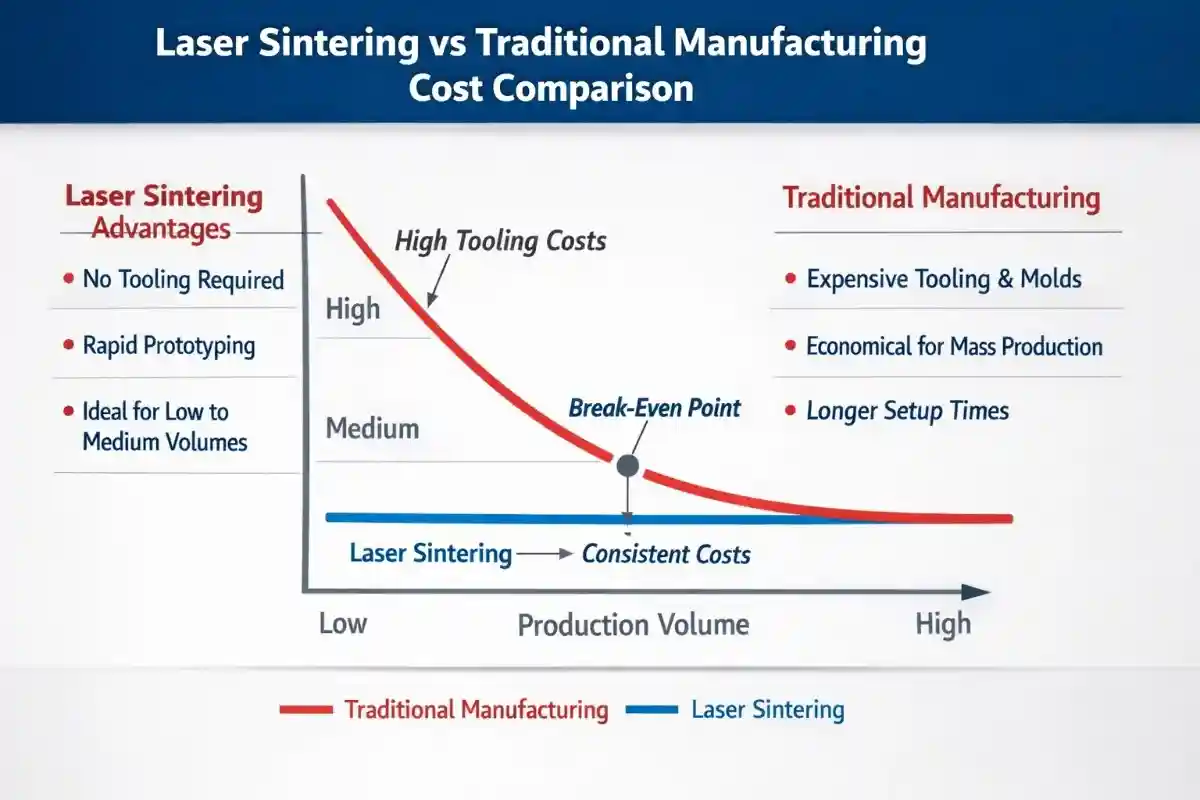
Production Volume Economics
The cost-effectiveness of each method depends heavily on production volume.
| Production Volume | Best Method |
|---|---|
| Low Volume / Prototyping | SLS Technology |
| Medium Volume | Hybrid Approach |
| High Volume | Traditional Manufacturing |
Industrial 3D Printing ROI
One of the biggest advantages of additive manufacturing is its strong industrial 3D printing ROI.
| Metric | Traditional | SLS |
|---|---|---|
| Time to Market | Slow | Fast |
| Customization Cost | High | Low |
| Design Iterations | Limited | Unlimited |
Hidden Costs to Consider
- Inventory holding costs
- Supply chain delays
- Maintenance and downtime
- Quality control and rework costs
Smart Manufacturing & Cost Optimization
Modern smart manufacturing integrates additive and traditional methods to optimize costs and efficiency.
- Hybrid production models
- AI-driven cost optimization
- IoT-enabled production monitoring
- Digital twin simulations
When to Choose Laser Sintering
- Low-volume production
- Complex part geometries
- Rapid prototyping needs
- Customization requirements
When to Choose Traditional Manufacturing
- High-volume production
- Standardized products
- Cost-sensitive mass manufacturing
Future Trends in Manufacturing Cost Optimization
- AI-driven production planning
- Automated additive manufacturing lines
- Sustainable manufacturing practices
- Decentralized production models
Conclusion
The choice between laser sintering and traditional manufacturing depends on your production goals, volume, and cost priorities. While traditional methods remain cost-effective for mass production, SLS technology offers unmatched flexibility, speed, and innovation for modern manufacturing.
By understanding this additive vs traditional manufacturing comparison, businesses can make informed decisions that maximize efficiency and ROI.
Looking to optimize your production costs? A hybrid approach combining both technologies may provide the best balance between cost and performance.