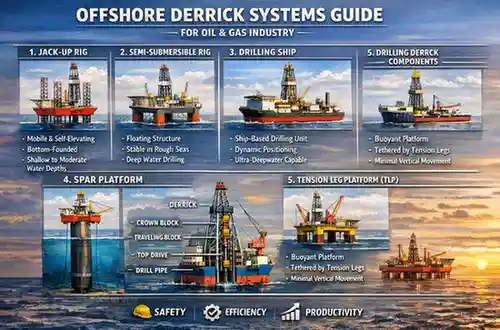
Offshore Derrick Systems Guide for Oil & Gas Industry
Offshore Derrick Systems Guide for Oil & Gas Industry
The global oil and gas industry relies heavily on advanced engineering systems to extract resources from challenging offshore environments. Among the most critical components of drilling operations are offshore derrick systems, which serve as the structural backbone of oil rigs.
These systems play a vital role in lifting, lowering, and supporting drilling equipment, ensuring efficient and safe operations in deepwater and ultra-deepwater environments. In this comprehensive guide, we explore the design, cost, applications, and benefits of modern offshore drilling machines.
What is an Offshore Derrick System?
An offshore derrick system is a tall steel structure installed on oil rigs that supports drilling operations. It is used to hoist and position drill pipes, casing, and other equipment required for oil and gas extraction.
These systems are engineered to withstand extreme environmental conditions, including high winds, waves, and corrosive marine environments.
Key Components of Offshore Derrick Systems
1. Derrick Structure
The main framework that supports the entire drilling system.
2. Crown Block
Located at the top of the derrick, it guides the drilling line.
3. Traveling Block
Moves up and down to lift and lower drilling equipment.
4. Drawworks
A mechanical system that controls the movement of the drilling line.
5. Rotary Table / Top Drive
Provides rotational force to the drill string.
Types of Offshore Derrick Systems
Conventional Derrick
Traditional lattice structure widely used in standard drilling operations.
Box-Type Derrick
Offers enhanced strength and stability for deepwater drilling.
Mast-Type Derrick
Portable and easy to assemble, suitable for mobile rigs.
Applications in Oil & Gas Industry
Offshore Oil Drilling
Used for extracting crude oil from beneath the ocean floor.
Natural Gas Exploration
Supports drilling operations for natural gas reserves.
Deepwater & Ultra-Deepwater Projects
Essential for complex offshore drilling operations.
Maintenance & Workover Operations
Used for repairing and maintaining existing wells.
Offshore Derrick Systems Cost in 2026
The cost of rig systems varies depending on size, capacity, and automation level.
| System Type | Price Range (USD) | Application |
|---|---|---|
| Standard Offshore Derrick | $5M - $20M | Shallow water drilling |
| Deepwater Derrick Systems | $20M - $100M | Deepwater projects |
| Ultra-Deepwater Systems | $100M - $500M+ | Advanced offshore operations |
Key Benefits of Offshore Derrick Systems
- High load-bearing capacity
- Enhanced operational efficiency
- Improved safety in drilling operations
- Support for advanced drilling technologies
- Scalability for different project sizes
Design Considerations
Structural Strength
Must withstand heavy loads and environmental stress.
Corrosion Resistance
Materials must resist saltwater corrosion.
Automation Integration
Modern systems include automated drilling controls.
Safety Standards
Compliance with international safety regulations is essential.
Comparison of Derrick Types
| Parameter | Conventional | Box-Type | Mast-Type |
|---|---|---|---|
| Strength | Moderate | High | Moderate |
| Mobility | Low | Low | High |
| Cost | Medium | High | Low |
Automation in Offshore Drilling
Modern offshore drilling machines integrate automation technologies for improved performance:
- Automated pipe handling systems
- Real-time monitoring sensors
- AI-driven drilling optimization
- Remote operation capabilities
ROI of Offshore Derrick Systems
Despite high initial investment, these systems deliver strong ROI through efficiency and productivity gains.
| Metric | Before Modern Systems | After Implementation |
|---|---|---|
| Drilling Speed | Moderate | High |
| Operational Downtime | High | Reduced |
| Safety Incidents | Higher | Significantly Reduced |
Global Market Trends
- Increased investment in offshore exploration
- Adoption of smart drilling technologies
- Focus on sustainable energy extraction
- Growth in deepwater drilling projects
How to Choose the Right Offshore Derrick System
- Evaluate project depth and complexity
- Consider load capacity requirements
- Analyze cost vs ROI
- Check compliance with safety standards
Expert Tips
- Invest in automation-enabled systems
- Focus on long-term operational efficiency
- Choose reliable equipment suppliers
Conclusion
Offshore derrick systems are a cornerstone of modern oil and gas infrastructure. Their ability to support complex drilling operations in extreme environments makes them indispensable for energy production.
With advancements in automation and engineering, these systems are becoming more efficient, safer, and cost-effective. Investing in high-quality oil drilling equipment ensures long-term success in offshore operations.
Ready to optimize your offshore drilling operations? Choosing the right derrick system can significantly impact productivity, safety, and profitability.